Category Archives: Psychology

Is "talent" just a fit to a particular cognitive paradigm?

I’ve been scouring the web for the past few hours, looking specifically for high achievers that feel they do not fit into any of society’s preconceived groups. Originally an attempt to elucidate the source of my own differences, what I found soon drove me to a hypothesis about the nature of talent: it isn’t an objective measure of ability in a specific area of endeavor so much as a matter of natural affinity for a particular cognitive style. When the style employed and the preference match up, skill is gained very rapidly and the depth of the individual’s intuition becomes quite a marvel to watch (because you’re speaking the individual’s “native language”!) However, this only happens on the talent’s own terms. Music lends a nice analogy: Mozart is widely considered among the best composers of all time, but chances are that he would be rather helpless if asked to write a piece in the style of Rachmaninoff, just as someone talented in logical manipulation, no matter to what extent, would likely quail before a geometric problem (unless also talented in spatial reasoning, which is indeed possible).

When the style and the preference do not match, talented people seem to be well-aware of – and quite discomforted by – the mismatch. This clash is most evident in authoritative social interactions, such as those typically found in the office or the classroom, as talented people may be forced into a foreign cognitive paradigm… and held there for potentially long spans of time. This creates friction of necessity. If it occurs frequently or consistently, as it often does, it will eventually permeate the talented individual’s worldview, creating the drive towards individual autonomy and the feeling of detachment from society that seem to be so common among the gifted. The following remedies are likely, in the order in which they are likely to be tried:

  1. Try to leverage overlaps between the foreign paradigm and the talented/native one while continuing to work primarily in the foreign paradigm (work within the system).
  2. Try to personally shift one’s immediate personal environment to utilize the native paradigm (make a local change).
  3. Try to alter one’s natural way of thinking to acomodate the organization’s (make a personal change – this almost inevitably fails).
  4. Try to find a better match among existing organizations (find a new system).
  5. Create a better match (change the system altogether).
  6. Cease the struggle and become increasingly bitter at such resistance to improvement (learned hopelessness).

The key to leveraging talent, then, is to allow the talented individual to make what adaptations are necessary for him to express his talent to the fullest. The desire for missing flexibility is the root cause, the very reason, for the drive towards individual autonomy so frequently expressed in high achievers. However, this drive is not for complete autonomy, per se, but simple operation on one’s own terms. There can be no way for a talented individual to excel, if not on his own terms!

The key for any sort of organization that wishes to cultivate or leverage talent, then, is to first (a) find the talent, and then (b) adapt to the talent, because talent can’t adapt to you.

Short-term conditions influence long term decisions

I call it the Grocer’s Hypothesis, because it’s probably something supermarkets have intuitively known. Customers who are hungry when they go shopping probably tend to buy more food than their satiated counterparts. This can be generalized; short-term conditions influence long-term decisions.

(Update: This has now been validated by a study at the University of Pennsylvania. Perhaps it should now be called the Grocer’s Theory :)).

One Key to Leadership

I’ve never been particularly charismatic, but I have a knack for leadership based on ideas – I have the ability to motivate people on the strength of my vision. One important lesson I’ve learned while doing this is that criticism is a positive thing.

Ideas, particularly radical ones, always attract critics. If they attract too many negative criticisms relative to the positive ones, you might wish to rethink the idea, or at least figure out why, but even ideas that have overwhelmingly positive criticisms are bound to get negative ones as well from time to time.

The key is never to take criticism as a bad thing. Use it as an opportunity to improve, and always thank the critic for bringing something you need to address to light. You’ll be surprised how quickly your critics warm to the idea when they see how willing you are to consider and address their concerns.

In the end, you’re both working towards ideals, after all.

Masks

Like most other INTJ types I know, I’ve adopted a “mask” to deal with strangers, since the merest expression of my true personality is apparently a threat to people’s well being. At least I don’t get beaten up for being different anymore, like I did in high school. Perhaps I misunderstood the aggression as being a social phenomenon, when in actuality, it was motivated by a subconscious sort of fear. Either way, I’ve always tried to avoid scaring people, because all I really wanted from anyone was to be either understood or left alone.

This causes some very powerful people to adopt a ruthless drive for mastery to compensate, and that’s a pity, because not only does their agony continue, but they become a special breed of tyrant, devoted to reciprocating the misery that was meted out on them – and more often than not, they are terribly effective at doing so.

The rest of us take it in silence and accept that it is merely transient. It doesn’t kindle vengeance in the same way, but it profoundly shapes one’s worldview. These are the “tortured geniuses” – unable to find any communal niche in society to which they can belong, they have no choice but to forge ahead alone.

I find it ironic that the very traits that have made me as successful as I have been thus far are the same ones that I need to hide, however. Not just from strangers, either – my father still thinks that anyone not currently in the workforce is worthless, despite the fact that the research I’ve published should have a much more profound impact on society because it’s an application of a unique talent. Any attempt to convey the fact that a stratification exists between the activities one can devote one’s time to – that some are indeed “higher” or “more worthy” than others – is met with outright refusal to believe, usually accompanied by some sort of personal attack. After all, he’s making money, right? To him, this is the primary justification and the imperative for what he makes of his life. The very thought that I am able to obtain a well-paying job but consider the ensuing truncation of my own ability to implement my visions an important reason to proceed with caution is completely foreign to him – and almost certainly to an overwhelming majority of the public, if the groups I’ve been forced to associate with throughout my life have been any sort of representative sample. To use a somewhat inaccurate analogy, he doesn’t yet realize that I’m not scoring the game in the same way that he is.

In the end, it’s yet another constraint that is added to the web that already slows us down – and by now, the web I’m caught in is getting very thick. I don’t wish harm on anyone – why can’t they simply accept who I am? They’ll gladly exploit the fruits of my labor and the labor of those like me, but they will never acknowledge the worth of the labor itself.

Self-efficacy and range of effect

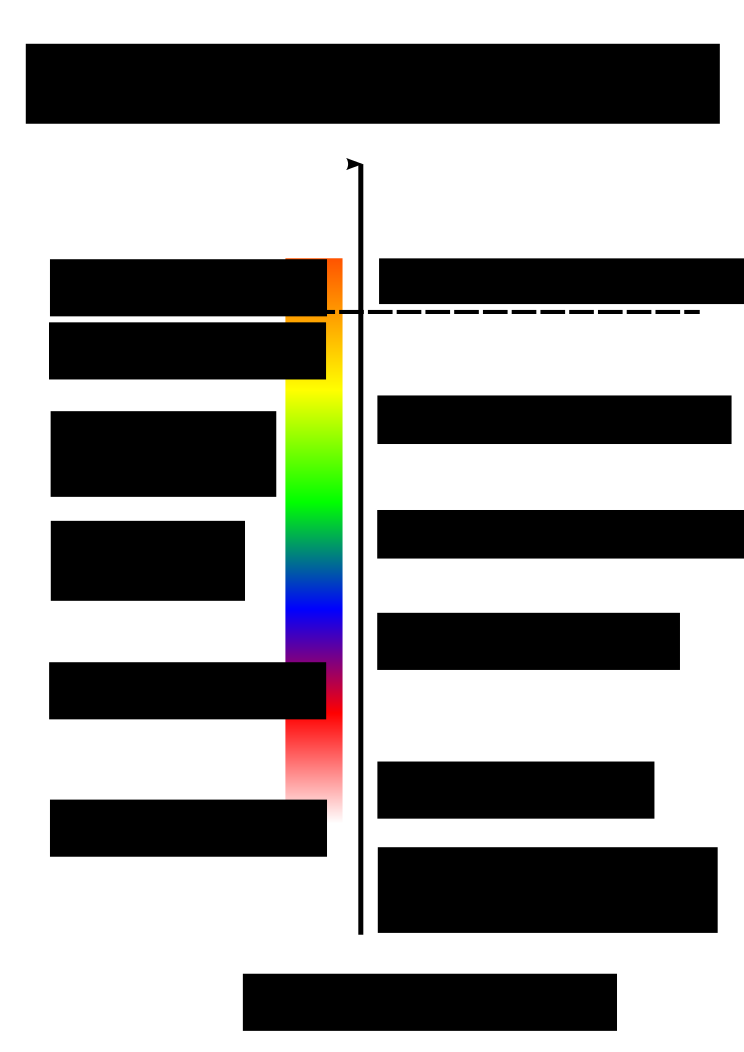
Today I came up with an interesting hypothesis: that the term known as self-efficacy (one’s perceived ability to accomplish tasks) determines the scale of what an individual will attempt to change. The reasoning is simple: when one perceives a clash between his own values and those of others, he invariably spends a certain amount of time, however brief, wondering “is this a problem with me or is this a problem with them?” Those with low self-efficacy (or low self-esteem in general) will conclude that the problem is with themselves, since their belief in their own ability is very weak. Those with higher self-efficacy will blame the practitioners within the system, believing that they are inaccurately expressing a concept that is fundamentally correct (the “if I did this, it would be better” effect). Those with the highest self-efficacy have such confidence in their own ability that they frame the clash as a problem with the system itself and, being very confident in their ability, set out to change it.

Therefore, lest you condemn those with high self-efficacy as being arrogant or pretentious, realize that this is the only way that society can ever advance. Were the world left only to those with low self-efficacy, humanity would no longer exist. What you deem arrogance is therefore virtuous behavior.

There is, however, a danger in having too much self-efficacy: this danger emerges when one begins to believe that the laws of reality, of logic, of causality, no longer apply to oneself. This results in attempting tasks that are inherently impossible, not because of the way society functions, but because their completion would cause a logical contradiction. Of course, we all undertake tasks such as these unknowingly; it becomes pathological when one begins to ignore the logical evidence against what one is attempting to do.

Certain levels of self-efficacy prompt introspection and/or criticism, which must be somehow resolved before one feels capable of taking on larger challenges. Successful resolution of these challenges (success being defined as resolution in a way that does not threaten the integrity of one’s self) causes self-efficacy to increase, as it provides evidence that one is doing “the right thing”.

Essentially, I believe that we can summarize this effect with the following figure:

Change and self efficacy

(Also available in SVG).

Procrastination and Anticipatory Fatigue

There’s a paper I need to continue working on today, but I’ve been writing papers all week and I’m exhausted. Nevertheless, I decided at this point that it was unwise to delay any further.

As soon as I resolved to begin it, I felt like all of the energy left me.

This was somewhat surprising, as I had expected that the fatigue associated with the activity (a feeling I always associated with about 2:00 PM on a 9-5 schedule of a boring job, probably because I tended to finish my work around 1 PM) would have an onset after work began. That does not seem to be the case, and may explain the root cause of procrastination – if one feels fatigued or otherwise unwell prior to beginning a task, he may never actually get around to doing it.